Outagamie County Dog Registration Information
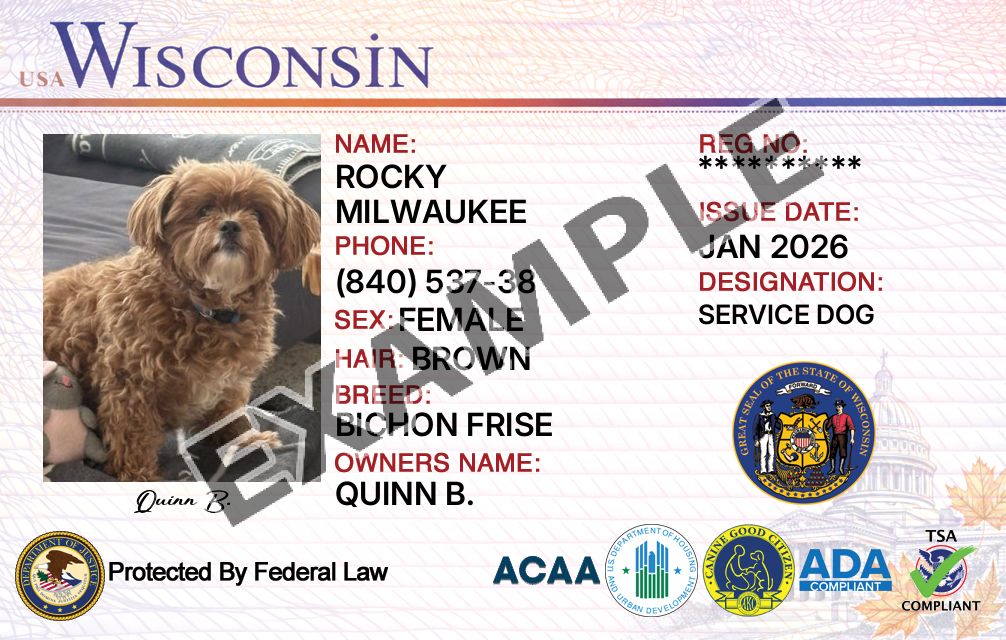
Service Dogs and Emotional Support Animals in Outagamie, Wisconsin
Registering (Licensing) a Dog in Outagamie County, Wisconsin: Service Dogs and Emotional Support Dogs
If you’re searching where do I register my dog in Outagamie County, Wisconsin for my service dog or emotional support dog, the key thing to know is that “registration” usually means getting a dog license in Outagamie County, Wisconsin—and that process is typically handled by your local city, village, or town clerk/treasurer, not by a single countywide office. In most cases, your service dog or emotional support dog must follow the same local licensing rules as any other dog, including rabies vaccination proof and annual renewal.
Important: “Dog License” vs. “Service Dog” vs. “Emotional Support Animal”
A dog license is a local government record (and tag) tied to rabies compliance and identification. A service dog is a specially trained dog protected under disability laws for public access. An emotional support animal (ESA) is not the same as a service dog and generally does not have public-access rights. You may need all three types of documentation in different contexts—but they are not interchangeable.
Where to Register or License Your Dog in Outagamie County, Wisconsin
Because licensing is commonly handled at the municipal level in Wisconsin, below are several official offices in Outagamie County where residents commonly obtain or renew a dog license. If your address is in a different city, village, or town than the examples below, contact your local municipal clerk/treasurer for the correct licensing location.
Example Office: Town of Grand Chute — Town Hall / Clerk Office
| Office name | Town of Grand Chute — Clerk Office (Town Hall) |
|---|---|
| Street address | 1900 W. Grand Chute Boulevard |
| City / State / ZIP | Grand Chute, WI 54913-9613 |
| Phone | 920-832-5644 |
| Not listed publicly on the page (email available via an on-page contact button) | |
| Office hours | Mon–Thu 7:00 a.m. – 4:30 p.m.; Fri 7:00 a.m. – 11:00 a.m. |
Tip: Grand Chute publishes dog licensing instructions through its municipal departments. If you live in Grand Chute, you typically license through the Town (not “Outagamie County” as a single office).
Example Office: Village of Kimberly — Clerk’s Office (Municipal Complex)
| Office name | Village of Kimberly — Clerk’s Office (Municipal Complex) |
|---|---|
| Street address | 515 W. Kimberly Avenue |
| City / State / ZIP | Kimberly, WI (ZIP not listed on the referenced office section) |
| Phone | 920-788-7500 |
| Not listed on the referenced licensing section | |
| Office hours | Mon–Thu 8:00 a.m. – 4:00 p.m.; Fri 8:00 a.m. – 12:00 p.m. |
Kimberly’s published guidance notes that dog licenses are annual and require a current rabies vaccination certificate as proof when licensing.
Example Office: Town of Greenville — Town Office (Dog License Processing)
| Office name | Town of Greenville — Town Office |
|---|---|
| Street address | W6860 Parkview Drive |
| City / State / ZIP | Greenville, WI 54942 |
| Phone | 920-757-5151 |
| Not listed on the referenced application | |
| Office hours | Not listed on the referenced application |
Greenville’s dog license form explains common requirements such as providing a rabies certificate and notes that licenses expire on December 31 each year.
Example Office: Town of Seymour — Treasurer (Dog License by Mail)
| Office name | Town of Seymour — Treasurer |
|---|---|
| Street address | W1866 Linsmeyer Rd (mail-in licensing address listed for payments and proof) |
| City / State / ZIP | Seymour, WI 54165 |
| Phone | 920-833-7488 |
| Listed on the office page (email address displayed there) | |
| Office hours | Not listed on the referenced page |
Seymour’s licensing instructions emphasize that dogs must be licensed and require proof of vaccination.
Rabies & Bite Reporting Resource: Outagamie County Public Health
| Office name | Outagamie County Public Health (Outagamie County Health & Human Services) |
|---|---|
| Street address | Not listed in the referenced pages provided |
| City / State / ZIP | Appleton, WI (full address not listed in the referenced pages provided) |
| Phone | Not listed in the referenced pages provided |
| Not listed in the referenced pages provided | |
| Office hours | Not listed in the referenced pages provided |
Public health typically becomes involved with rabies exposure guidance, bite incident follow-up, and quarantine protocols—separate from the municipal dog license tag you purchase each year.
Not sure which office applies to your address?
If you have an “Appleton” mailing address, you might still live in a different municipality (for example, a town or village). The right place to get an animal control dog license Outagamie County, Wisconsin depends on your municipality of residence. When in doubt, call your local clerk/treasurer first and confirm where to submit your rabies certificate and fee.
Overview of Dog Licensing in Outagamie County, Wisconsin
What “Registering a Dog” Usually Means
In Wisconsin, most people say “register my dog” when they mean buying or renewing a dog license. A license is typically an annual requirement that results in a numbered tag for your dog’s collar. That tag helps prove the dog is licensed and can speed up reunification if a dog is found roaming or brought to a shelter.
The Legal Baseline: Wisconsin Dog Licensing
Wisconsin law establishes the statewide requirement for licensing dogs over a certain age. Under Wisconsin Statutes § 174.05, owners of dogs more than 5 months old must obtain a license and pay the dog license tax each year (or by the time the dog becomes 5 months old). Local governments then administer the process, set local procedures, and issue the physical tags.
Rabies Vaccination Is Central to Licensing
A dog license is closely tied to rabies compliance. Many Outagamie County municipalities require you to provide a current rabies vaccination certificate before a license can be issued. Some local guidance also highlights that you must license annually even if your rabies vaccine is a multi-year vaccine—your rabies documentation must still be current and on file as required by the municipality issuing the license.
Do Service Dogs and Emotional Support Dogs Need a License?
In most situations, yes. A dog’s status as a service dog or emotional support dog typically does not replace municipal requirements to obtain a dog license in Outagamie County, Wisconsin. Think of licensing as a local public-health and identification system, while “service dog” status is a legal accessibility status based on training and disability-related need.
How Dog Licensing Works Locally in Outagamie County, Wisconsin
1) Find Your Municipality (City, Village, or Town)
Outagamie County includes multiple municipalities, and each one can have its own dog licensing workflow. This is why people often struggle with where to register a dog in Outagamie County, Wisconsin. The county boundary does not automatically tell you the licensing office—your municipality of residence does.
2) Confirm Age & Annual Timing Rules
Many local forms and pages reference the statewide rule that a dog typically must be licensed once it is more than 5 months old. Licensing is commonly annual. Some municipalities also publish local renewal deadlines (for example, reminders that renewals are due by a specific spring date and that late fees may apply after that date). Always check your local rules so you don’t get surprised by late fees or enforcement actions.
3) Gather Proof of Rabies Vaccination
Most municipalities require proof of current rabies vaccination before issuing a license tag. Commonly accepted proof is a rabies vaccination certificate from a licensed veterinarian. Some local instructions emphasize that you should retain a copy for your records and submit a copy with your payment or application.
4) Apply In Person, By Mail, or Via Drop Box (Varies by Office)
Local offices may allow multiple submission options. For example, some municipal clerk offices describe:
- In-office licensing at the town hall or municipal complex during office hours
- Mail-in licensing where you send payment and copies of required documents
- Drop box options at municipal buildings (where available)
If you are applying by mail, many offices request a self-addressed stamped envelope so they can mail back your tag and receipt efficiently.
5) Keep Your Tag and Records Accessible
After your dog is licensed, attach the issued tag to the dog’s collar/harness as required locally and keep the paperwork (rabies certificate and license receipt) in a safe place. If you ever need to prove licensing quickly (for example, after a lost-dog incident), having those documents readily available can help.
Service Dog Laws in Outagamie County, Wisconsin
Service Dog Status Is Not Issued by the Dog License Office
A common misunderstanding is that you must “register” a service dog at a county office. In reality, a service dog’s legal status generally comes from:
- the handler having a disability (as defined by applicable disability law), and
- the dog being trained to perform specific tasks that mitigate the disability.
Your municipal dog licensing office issues a license tag, not a certification of service-dog training or disability status.
Dog Licensing Still Applies to Service Dogs
Even when a dog is a legitimate service dog, the dog is still typically expected to comply with local requirements such as rabies vaccination and a dog license in Outagamie County, Wisconsin. Service-dog laws focus on access and anti-discrimination protections, while dog licensing focuses on local administration, identification, and rabies compliance.
Public Access: What Matters in Day-to-Day Life
For everyday public access, service dog rules generally revolve around whether the dog is trained to perform tasks and whether the dog is under control and housebroken. A dog license tag may be required by local ordinance, but it is not the same thing as proof of service-dog training. If you’re ever unsure, it’s wise to keep your rabies and license documentation organized, but remember: the license itself does not “make” a dog a service dog.
Emotional Support Animal Rules in Outagamie County, Wisconsin
An ESA Is Not a Service Dog
An emotional support animal (ESA) can provide comfort that helps with a mental or emotional health condition, but ESAs are typically not trained to perform specific disability-mitigating tasks the way service dogs are. Because of that difference, an ESA generally does not have the same broad public-access rights as a service dog (for example, in restaurants or most retail environments).
Dog Licensing Still Applies to ESAs
If your emotional support dog lives with you in Outagamie County, you should still plan to obtain the appropriate municipal dog license, maintain rabies vaccination compliance, and follow local leash and nuisance rules. In other words, even if your dog is an ESA, you still need to answer the practical question: where to register a dog in Outagamie County, Wisconsin—which usually means contacting your city/village/town clerk/treasurer.
Housing Situations: What You Should Prepare For
In housing contexts, a landlord or property manager may have a process for accommodation requests, and they may ask for documentation consistent with housing rules. That process is separate from municipal licensing, which focuses on local compliance (rabies and annual dog license).
Frequently Asked Questions
Disclaimer
Licensing requirements and office locations may change. Residents should verify details with their local animal services office within Outagamie County, Wisconsin.
Register A Dog In Other Wisconsin Counties
Select your county below to get started with your dog’s ID card. Requirements and license designs may vary by county, so choose your location to see the correct options and complete your pup’s registration.
- Adams County Dog Registration
- Ashland County Dog Registration
- Barron County Dog Registration
- Bayfield County Dog Registration
- Brown County Dog Registration
- Buffalo County Dog Registration
- Burnett County Dog Registration
- Calumet County Dog Registration
- Chippewa County Dog Registration
- Clark County Dog Registration
- Columbia County Dog Registration
- Crawford County Dog Registration
- Dane County Dog Registration
- Dodge County Dog Registration
- Door County Dog Registration
- Douglas County Dog Registration
- Dunn County Dog Registration
- Eau Claire County Dog Registration
- Florence County Dog Registration
- Fond du Lac County Dog Registration
- Forest County Dog Registration
- Grant County Dog Registration
- Green County Dog Registration
- Green Lake County Dog Registration
- Iowa County Dog Registration
- Iron County Dog Registration
- Jackson County Dog Registration
- Jefferson County Dog Registration
- Juneau County Dog Registration
- Kenosha County Dog Registration
- Kewaunee County Dog Registration
- La Crosse County Dog Registration
- Lafayette County Dog Registration
- Langlade County Dog Registration
- Lincoln County Dog Registration
- Manitowoc County Dog Registration
- Marathon County Dog Registration
- Marinette County Dog Registration
- Marquette County Dog Registration
- Menominee County Dog Registration
- Monroe County Dog Registration
- Oconto County Dog Registration
- Oneida County Dog Registration
- Ozaukee County Dog Registration
- Pepin County Dog Registration
- Pierce County Dog Registration
- Polk County Dog Registration
- Portage County Dog Registration
- Price County Dog Registration
- Racine County Dog Registration
- Richland County Dog Registration
- Rock County Dog Registration
- Rusk County Dog Registration
- Sauk County Dog Registration
- Sawyer County Dog Registration
- Shawano County Dog Registration
- Sheboygan County Dog Registration
- St. Croix County Dog Registration
- Taylor County Dog Registration
- Trempealeau County Dog Registration
- Vernon County Dog Registration
- Vilas County Dog Registration
- Walworth County Dog Registration
- Washburn County Dog Registration
- Washington County Dog Registration
- Waukesha County Dog Registration
- Waupaca County Dog Registration
- Waushara County Dog Registration
- Winnebago County Dog Registration
- Wood County Dog Registration